1. Executive Summary
For decades, metadata was the quiet housekeeping of enterprise IT — a schema diagram drawn once during a project kickoff, a data dictionary that went stale the week after it was published, a column list nobody updated once the integration shipped. It mattered, but it was rarely urgent. Systems could limp along on outdated metadata because the humans in the loop could still reason their way around the gaps.
Agentic AI removes that safety net. When an AI agent — not a person — is the one selecting fields, evaluating conditions, retrieving documents, and taking action, it has no intuition to fall back on when metadata is missing, wrong, or out of date. It only has what the platform tells it is true. If that picture is stale, the AI's decisions are built on sand, no matter how capable the underlying model is.
This white paper traces metadata's evolution from a background discipline to a front-line requirement for trustworthy enterprise AI. We look at why the old "map it once" approach quietly failed even before AI arrived, why metadata now functions as a shield against bad data reaching AI decisions, and why a living, unified metadata architecture is the foundation that makes everything else — workflows, prompts, RAG, agentic automation — actually work. We close by examining how the appRules AI Automation Engine was built with metadata as first-class architecture, not an afterthought.
Key Findings
- Metadata has quietly moved from a documentation exercise to the control layer that determines whether enterprise AI is accurate, governed, and trustworthy
- Stale or incomplete metadata is now a primary source of AI error — not because models are weak, but because they are reasoning from an outdated map of the data
- Enterprises need two kinds of metadata working together: structural metadata (entities, columns, foreign keys, picklists) and document metadata (classification, custom fields, retrieval context) — most platforms only address one
- appRules treats metadata as a living, refreshable asset used identically at design-time and runtime, across a vast library of connected data sources and unstructured content alike
2. Metadata: A Discipline the Industry Has Always Underrated
Metadata has never lacked champions. Data architects have argued for decades that a well-maintained data dictionary, a governed schema, and documented lineage were worth the investment. And yet, in most enterprises, metadata management consistently lost the budget argument to features that shipped faster and demoed better. It was treated as overhead — necessary, but never the main event.
The One-Time Mapping Era
Integration projects captured a schema snapshot at kickoff — an entity list, a set of field mappings — and moved on. The mapping was accurate on day one and increasingly wrong every day after.
The Data Dictionary as Documentation
Data dictionaries were written to satisfy audits and onboard new developers — reference material, not runtime infrastructure. Nothing in the system actually depended on them being current.
Governance Programs, Bolted On
Enterprise data governance initiatives tried to formalize metadata as policy — stewardship roles, review cycles, cataloging tools — but largely as a compliance layer sitting alongside the systems that actually ran the business, not inside them.
Agentic AI Arrives — And the Gap Becomes Load-Bearing
AI agents don't read documentation. They act on whatever metadata the platform exposes to them, in real time, at execution speed. A discipline that tolerated staleness for years suddenly cannot tolerate staleness for a single workflow run.
Every stage above solved a real problem of its era. But every stage also shared the same underlying assumption: that metadata was something humans consulted, not something systems depended on moment to moment. That assumption held up reasonably well when people were in every decision loop, cross-checking a screen against their own knowledge of "how the data really looks." It does not hold up when the decision loop is an AI agent with no such knowledge of its own.
3. The AI Era Changes the Stakes
Generative and agentic AI did not create the metadata problem — it exposed it. An AI model has no innate sense of what fields exist on your Salesforce Opportunity object, what values are valid in your ServiceNow priority picklist, or which foreign key relates a claim to a policyholder. It only knows what the platform tells it, at the moment it asks. Every gap between what the metadata says and what the data actually looks like becomes a gap the AI cannot see — and will confidently reason across anyway.
Three Ways Stale Metadata Becomes AI Failure
🎯 Wrong Fields, Confident Answers
An AI prompt built against an outdated schema references a column that was renamed six months ago. The AI doesn't error out — it substitutes, guesses, or hallucinates a plausible-sounding value instead.
📋 Invalid Values, Silently Accepted
Without a live picklist to validate against, an AI-populated field can carry a value that was never a legitimate option — passing structural checks while violating business meaning entirely.
The third failure mode is more subtle, and arguably the most consequential for retrieval-augmented generation specifically: context loss at scale. An AI agent asked to retrieve "the latest contract for this customer" needs to know not just where documents live, but how they're classified, dated, and related to the customer record — metadata that, if missing or wrong, causes the agent to retrieve the wrong document with complete confidence, and no way for anyone downstream to know it happened until the consequences surface.
"A person confronted with an outdated schema pauses and asks a question. An AI agent confronted with an outdated schema does not pause — it proceeds, confidently, on the wrong information."
This is the structural reason metadata has moved from background discipline to front-line requirement. It is not that AI made metadata more important in the abstract — it is that AI removed the human checkpoint that used to catch metadata drift before it caused damage.
4. Metadata as a Shield
If ungoverned metadata is a source of AI risk, well-governed metadata is a form of defense — a shield that stands between raw, messy enterprise data and the AI systems making decisions from it. This is not a metaphor for a compliance checkbox; it describes concrete architectural behavior that either exists in a platform or does not.
🛡️ Type Enforcement at the Source
When every column's data type is known and enforced, an AI action cannot silently write a string into a date field or a text value into a numeric one — the shield catches the mismatch before it propagates.
📌 Controlled Vocabularies
Live picklists mean an AI-driven condition or classification can only select from values that are actually valid — eliminating an entire category of "technically successful, semantically wrong" outcomes.
🔗 Relationship Integrity
Cataloged foreign keys and primary keys mean AI-selected records are related the way the business actually relates them — not the way a stale mapping once assumed they were related.
🌐 Environment Awareness
Metadata scoped per environment prevents a workflow validated against Development data from making decisions using Production assumptions, or vice versa — a quiet but common source of AI errors in fast-moving deployments.
None of these protections require the AI model itself to be more careful. They are architectural — enforced by the platform, independent of what any particular model produces on any particular call. That is precisely what makes metadata a shield rather than a suggestion: it holds even when the AI is confused, even when a prompt is ambiguous, even when a new data source is connected under time pressure.
5. Two Kinds of Metadata, One Architecture
Enterprises typically encounter metadata in two forms, and most platforms are only built to handle one of them well. A robust architecture needs both, working from the same governing principles.
🗄️ Structural Metadata
The schema-level catalog of your structured systems — the shape of the data itself.
- Entities and their columns
- Foreign keys and primary keys
- Picklists and their valid entries
- Connections, environments, and API calls
📑 Document Metadata
The descriptive layer over unstructured and semi-structured content — the context around the content.
- Custom classification and tagging
- Document type, date, and ownership
- Access and permission attributes
- Chunk-level context for retrieval
Structural metadata governs how AI interacts with your databases, CRMs, and line-of-business systems — the fields, relationships, and valid values that determine whether a workflow decision is even coherent. Document metadata governs how AI interacts with your unstructured content — contracts, policies, knowledge bases, support tickets — determining whether a retrieval-augmented answer is grounded in the right material or merely material that happened to match on keywords.
Platforms that only solve one side of this equation leave the other exposed. A system with excellent schema governance but no document metadata strategy will still let a RAG pipeline retrieve the wrong contract version. A system with sophisticated document tagging but no structural metadata will still let an AI agent misuse a foreign key relationship it never actually understood. The two disciplines have to be architected together, not bolted on separately.
6. One Metadata Model, Every Data Source
appRules connects to a vast and ever-growing library of data source types — Salesforce, Dynamics 365, Dataverse, SQL Server, PostgreSQL, MySQL, Oracle, Snowflake, SharePoint, HubSpot, ServiceNow, Google Drive, OneDrive, Excel, Zoho CRM, and hundreds upon hundreds more. For every one of them, appRules captures and manages rich, living structural metadata: entities, columns, foreign keys, connections, picklists, and API calls.
The distinction that matters is not that this metadata is captured — most platforms capture a schema snapshot somewhere. What matters is that appRules treats that metadata as a living asset rather than a one-time setup step. A single Refresh Metadata action re-syncs entities, columns, foreign keys, picklists, and API calls against the live source, so the model never drifts out of date the way traditional data dictionaries always eventually do.
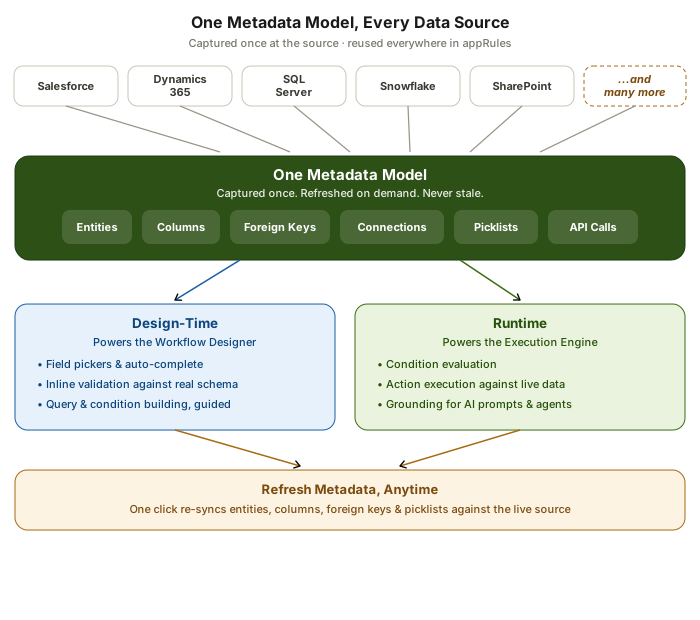
A vast library of data source types all feed the same metadata model — entities, columns, foreign keys, connections, picklists, and API calls — captured once and reused by both the workflow designer and the runtime engine.
One Model, Reused Everywhere
That single metadata model is reused across the entire platform rather than existing as a documentation artifact off to the side:
- The workflow designer uses it to power field pickers, query building, and inline validation — a developer sees only real, current fields and relationships
- Conditions and actions use it at runtime to know what's valid and to select the right data records before a workflow executes
- appRules.AI uses it to ground prompts, decision tables, and AI agents in your actual data shape — instead of a guess encoded in a prompt template months ago
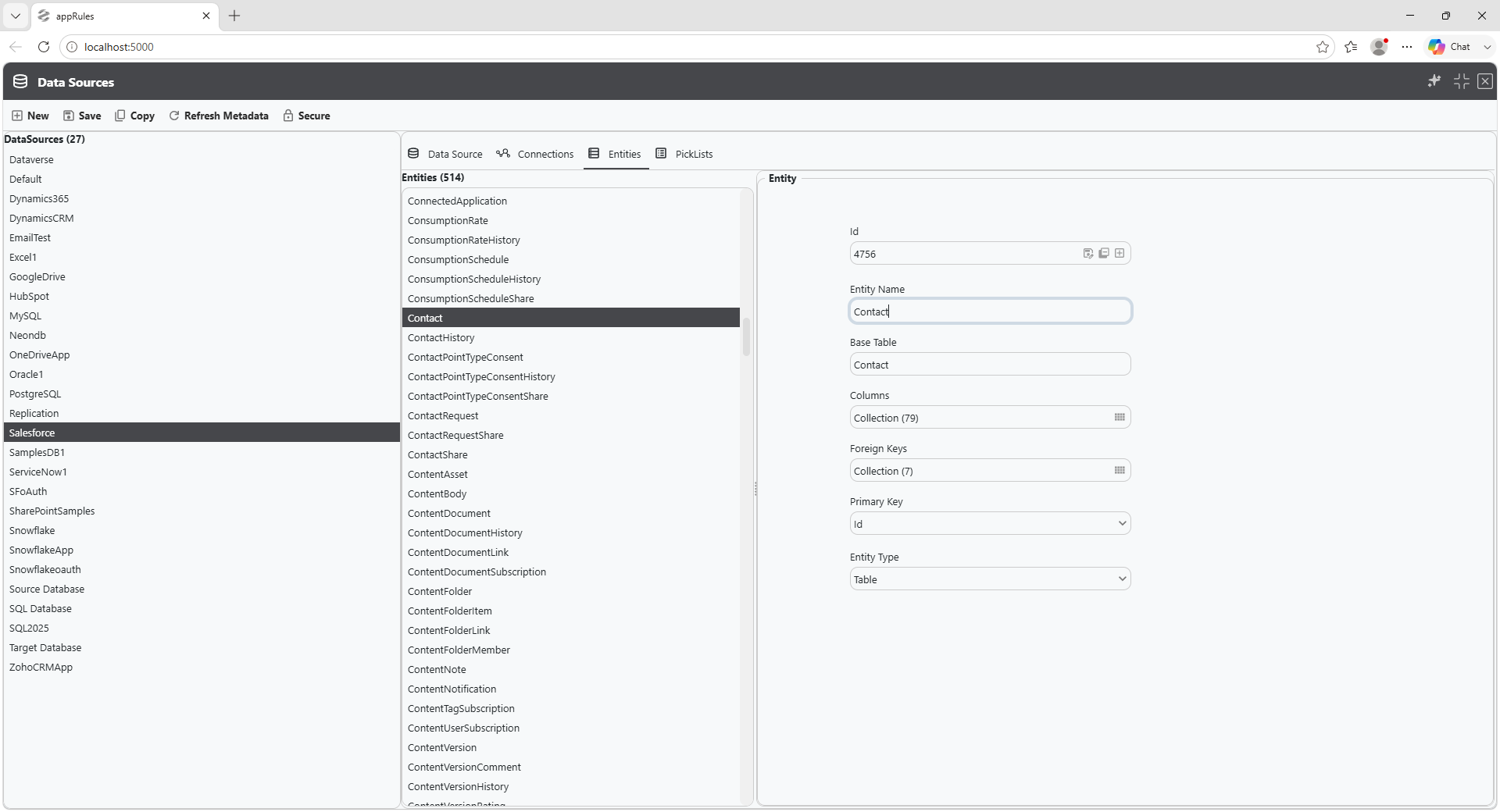
Every entity discovered on a connected data source — in this example, 510 of them — comes with its full column list, foreign keys, and primary key already mapped and ready to use, without hand-built documentation.
Because the same model drives both design-time and runtime, there is no separate "documentation" that can silently diverge from "reality." The metadata a developer sees while building a workflow is the same metadata the AI agent consults when that workflow executes weeks or months later. Refreshing it is a single action, not a re-mapping project.
Connections Are Metadata Too — Build Before You Connect
The deepest implication of treating metadata as a first-class architectural layer is one most platforms never achieve: the definition of a connection is itself metadata, entirely separate from the live connection it describes. In appRules, this applies not just to data sources, but to every external dependency a workflow can have:
- Data Sources — Salesforce, SAP, SQL Server, Snowflake, and hundreds more
- AI Providers — OpenAI, Azure AI, Anthropic, Amazon Bedrock, Google AI, and 20+ others
- Embedding Generation Services — the models that turn content into vectors
- Embedding Storage Services — Pinecone, Redis, Chroma, Qdrant, Weaviate, and more
- Web Search Services — Bing, Brave, Google
- Tools — Actions, Conditions, Functions, REST APIs, Scripts, Workflows, and Workflow Activities
Each of these is defined once, by name, as a metadata object — independent of whether a live, authenticated connection to the underlying system exists yet. A developer can design an entire workflow against a Salesforce data source definition, an Anthropic AI provider definition, and a Pinecone vector store definition, referencing their entities, fields, and configuration by name throughout — without ever supplying a live credential or reaching the actual endpoint.
"A connection is something you test against and run in production against. It is not something development should ever have to wait on."
This is only possible because metadata and connectivity are architecturally decoupled. Development proceeds entirely against the metadata layer — the entities, columns, picklists, provider configurations, and tool signatures that are already fully known and cataloged. Live connections, credentials, and Secure-locked configuration are only required when a workflow moves to Test or Production environments, at which point the same named definition is simply pointed at a real, authenticated endpoint. Nothing about the workflow logic, the AI prompts, or the field references has to change.
The practical effect is significant: teams are no longer blocked waiting on IT to provision a Salesforce sandbox, a production OpenAI key, or a Pinecone index before development can begin. The metadata is enough to build, validate, and review an entire workflow. Connectivity becomes a late-stage, environment-specific concern — exactly where it belongs — rather than a prerequisite that gates every sprint.
7. Smart Metadata for RAG
Retrieval-augmented generation is only as good as what it retrieves — and what it retrieves depends entirely on the metadata attached to the underlying content. appRules extends the same living-metadata philosophy to unstructured documents, giving RAG pipelines the context they need to retrieve precisely, not just plausibly.

Custom metadata schemas — from simple categorization to conditional, hierarchical fields — are defined to match your document types and business needs.
Rich document metadata transforms RAG performance in three concrete ways:
⚡ Precision Filtering
Pre-filter by date, category, permissions, or custom attributes before semantic search runs — narrowing the field to relevant candidates instead of searching everything and hoping the ranking sorts it out.
🚀 Hybrid Retrieval Power
Metadata attributes combine with semantic similarity, so retrieval reflects both what a document means and what it factually is — the right document type, from the right time period, for the right party.

Document metadata sits alongside embeddings in the retrieval pipeline — filtering, classifying, and grounding results before generation ever begins.
This is the document-metadata half of the shield described in Section 4, applied to unstructured content specifically: an AI agent asked to summarize "the current policy" cannot accidentally retrieve last year's superseded version if version and effective-date metadata are captured and enforced as part of the retrieval logic itself.
8. appRules in Action — Metadata-Driven, End to End
Metadata architecture is not a single feature in appRules — it is the substrate that other capabilities are built on. The table below traces how structural and document metadata each show up across the platform.
| Platform Capability | How Metadata Drives It | Type |
|---|---|---|
| Workflow Designer | Field pickers, query building, and inline validation reflect the live schema — no guessing at column names | Structural |
| Conditions & Actions | Runtime evaluation checks values against real types and picklists before a workflow proceeds | Structural |
| SmartPrompt Builder | Context arguments are grounded in actual entity and column definitions, not assumed field names | Structural |
| AI-Powered Decision Tables | Deterministic rules and AI-handled edge cases both reference the same validated field definitions | Structural |
| Refresh Metadata | Re-syncs entities, columns, foreign keys, picklists, and API calls on demand — the model never goes stale | Structural |
| Document Classification Agents | Assign single or multiple classifications to records automatically, driven by configurable metadata schemas | Document |
| RAG Retrieval | Precision filtering and hybrid retrieval combine metadata attributes with semantic search for grounded answers | Document |
| AI Agents (Folder & File) | Read and reason over both the structural metadata of connected systems and the document metadata of content they access | Both |
This is deliberate architecture, not coincidence. Because appRules treats metadata as a living, queryable asset rather than a static reference document, every one of these capabilities inherits accuracy and governance automatically — a developer or AI agent working in appRules is, by construction, working from the same current picture of the data every time.
9. Business Impact
A robust metadata architecture pays off across the dimensions that matter most to enterprise decision makers evaluating AI initiatives.
Fewer AI Errors, Traced to Their Root Cause
Many "AI accuracy" problems are, on inspection, metadata problems — a prompt referencing a renamed field, a classification drawing on an outdated schema, a retrieval pulling the wrong document version. Addressing metadata at the architecture level removes an entire category of failure before it ever reaches the model.
Faster Onboarding of New Data Sources
Because appRules automatically inventories entities, columns, foreign keys, and picklists on connection, new systems become AI-ready in the time it takes to connect and refresh — not the weeks a manual schema-mapping project traditionally requires.
Development That Doesn't Wait on Connections
Because Data Sources, AI Providers, Embedding Generation Services, Embedding Storage Services, Web Search Services, and Tools are all defined and stored as metadata, development teams can design, build, and review complete workflows before a single live connection exists. A production Salesforce credential, an OpenAI API key, or a Pinecone index only needs to be in place when the workflow reaches Test or Production — not on day one of the sprint. Projects that once stalled for weeks waiting on IT provisioning or vendor onboarding can start building the same day the definitions are named.
Durable Governance, Not a One-Time Project
A metadata catalog that refreshes on demand stays accurate as source systems evolve — turning governance from a periodic audit exercise into a standing architectural property of the platform.
Retrieval You Can Trust
RAG systems grounded in rich, current document metadata retrieve with precision rather than plausibility — a meaningful difference in regulated industries where "close enough" is not an acceptable answer.
| Business Outcome | Without a Living Metadata Architecture | With appRules |
|---|---|---|
| Schema accuracy over time | Drifts from reality after the initial mapping | Refreshed on demand, never stale |
| New data source onboarding | Manual schema mapping, weeks of effort | Automatic inventory on connection |
| Development start | Blocked until data sources, AI providers, and tools are live and connected | Begins immediately against metadata — connections only needed for Test & Production |
| AI field & value accuracy | Dependent on prompt authors' manual knowledge | Grounded in the live catalog automatically |
| RAG retrieval precision | Semantic similarity alone, prone to plausible mismatches | Metadata-filtered hybrid retrieval |
| Governance posture | Periodic audit, quickly outdated | Continuous, architectural |
10. Conclusion
Metadata spent decades as the discipline enterprises knew they should invest in and consistently under-invested in anyway, because the cost of neglect was diffuse and the humans in the loop absorbed most of it quietly. Agentic AI removes that buffer. An AI agent acts on exactly the metadata it is given, at the speed the platform allows, with no instinct to catch what a person would have caught.
That makes metadata something enterprises can no longer treat as background housekeeping. It is the shield that keeps bad data, stale schemas, and misclassified documents from reaching AI decisions — and it is the foundation that every other AI capability, from workflow automation to RAG, is quietly built on top of.
appRules was architected around this reality from the start. Structural metadata and document metadata are captured, refreshed, and reused as one living system — powering the workflow designer, the runtime execution engine, and appRules.AI identically, across a vast and ever-growing library of connected data sources.
Without this metadata architecture, appRules simply could not deliver what it delivers. It is not a supporting feature — it is the foundation everything else stands on.