1. Executive Summary
For years, enterprise AI governance meant trusting the model and checking its work afterward. That assumption is ending. In October 2026, Microsoft's chief executive publicly urged the industry to treat AI models as insider risks — to assume they are compromised, contain them from the start, and separate the supply of intelligence from the authority over it.
For enterprises automating real business processes, the practical question is no longer whether to contain AI, but what contains it. This paper argues that the strongest answer already exists: a mature, deterministic rules engine that sits between the model and everything it touches. The model recommends. The rules engine decides what actually happens — and records it.
The model advises. The rules engine decides. Every decision is recorded.
appRules was built this way. Its rules engine has been running enterprise processes in production for more than a decade, and AI was added inside it — not the other way around.
2. The Industry Says It Out Loud
On October 10, 2026, Microsoft CEO Satya Nadella published an article on X, Models as Insider Risks in the Super Intelligence Era. His starting point is blunt: unlike traditional software, today's models can't be traced to a specific code path — yet enterprises are giving them access to sensitive data and the ability to take mission-critical actions. His answer is containment:
“We must assume a model is compromised and contain it from the start.”
— Satya Nadella, Chairman and CEO, Microsoft, Models as Insider Risks in the Super Intelligence Era, X, October 10, 2026
He describes an emergency brake that lets any authorized person pause or shut down a model mid-task, and sets out principles for the systems around models: model diversity, observing everything through tamper-proof, human-readable evidence, continuous verification, independent controls, independent auditability, and incident disclosure. He also makes clear that responsibility can't be outsourced — a model provider's assurances do not relieve the organizations deploying it.
A day earlier, Microsoft President Brad Smith made a similar point in plainer terms, warning that AI today is “less regulated than a carton of milk.”
When the leaders of one of the world's largest technology companies say this publicly, enterprises should take it as a design requirement — not a debate.
3. Separate the Model From What Governs It
The most important idea in Nadella's article is architectural, and he states it in a single sentence:
“In other words, we need to separate the supply of intelligence from the authority over it.”
— Satya Nadella, Chairman and CEO, Microsoft, Models as Insider Risks in the Super Intelligence Era, X, October 10, 2026
He is explicit that the controls governing what a model can access and what actions it can take must sit outside the model. If the same model that produces an answer also decides what to do with it, there is nothing to contain it — a compromised or mistaken model simply acts.
⚠️ Model-Driven Automation
- The model decides and acts
- Safety depends on the model behaving as intended
- Other models are asked to check its work
- Behavior is hard to predict, reproduce, or explain
✅ Rules-Governed Automation
- The model recommends; deterministic rules decide
- Every action comes from a validated, tested library
- Conditions and post-conditions gate every write
- Behavior is predictable, reproducible, and recorded
This is precisely the appRules architecture. The model supplies the intelligence; the rules engine holds the authority. In appRules, an AI response never acts on its own. It flows into Conditions, Decision Tables, and validated Actions — business rules that a human can read, test, and sign off on — and only those rules change data in enterprise systems.

Conditions are defined once, named, and evaluated deterministically — the same input always produces the same result.
4. Contain What the Model Sees and Says
Containment doesn't begin when a model acts. It begins with what the model is given. Nadella points to the practices enterprises already use for powerful insiders — establishing identity, limiting privileges, logging activity, and drawing containment boundaries. For an AI model, limiting privileges starts with limiting what it can see.
In appRules, every prompt is built in the SmartPrompt Builder, and the context a model receives is chosen deliberately. The Context Picker lets builders select the specific context variables a prompt draws on — the fields and values from real, governed data sources that the task requires, and nothing more. The model never gets open-ended access to enterprise data; it gets exactly the context the workflow hands it.

The SmartPrompt Builder's Context Picker: builders choose exactly which context variables a prompt draws on — least privilege, applied to what the model sees.
The SmartPrompt Builder contains what the model says, too. Its prompt and context engines give a model a specific, deterministic role — such as a condition evaluation engine that returns only a clean true or false — so the model's output is a narrow, checkable answer that the rules engine can act on, not open-ended text it must interpret. And with Partial Preview, the fully merged prompt and context can be inspected before any AI call is made: the evidence of what the model will see exists before the model sees it.
👁️ Least Privilege for Context
The Context Picker defines exactly what data a model receives — selected from governed sources, never open-ended.
🎯 Narrow, Checkable Output
Prompt and context engines assign deterministic roles, so answers arrive in a form the rules engine can evaluate.
🔍 Observable Before It Runs
Partial Preview shows the merged prompt and context with the AI never called — inspection at zero cost.
🔁 Reusable and Consistent
SmartPrompts can be shared and reused, so the same task is framed the same way everywhere it runs.
5. Why a Mature Rules Engine
Nadella's article doesn't call for a new kind of magic. It calls for an engineering approach: wrapping unpredictable models in deterministic system design, human oversight, and dependable operating procedures — with industry standards wherever today's fall short.
He also points out that this isn't new territory. Enterprises have spent decades refining how to contain powerful actors inside the organization, and he grounds the need for external controls in an information-security principle dating back to the 1970s. Strong, deterministic system design around a non-deterministic model is exactly what an enterprise rules engine is.
🎯 Deterministic
The same input and the same rules always produce the same outcome. A rules engine doesn't drift, hallucinate, or reinterpret its instructions.
🧪 Testable
Rules can be validated before they run and tested against known cases — something no prompt can guarantee.
📖 Readable
Conditions, Decision Tables, and Action Chains can be read and approved by business owners and auditors — not just engineers.
🏭 Proven in Production
The appRules rules engine has run enterprise data integration, migration, replication, and decision automation in production for more than a decade.
A containment layer invented alongside the AI it governs inherits the AI's immaturity. A mature rules engine brings years of hardening to the problem from day one.

AI Powered Decision Tables: AI can inform a decision, but the table defines what each outcome means and what happens next.
6. The Containment Principles, Mapped
Each of the principles in Nadella's article maps to a capability appRules provides today.
| Principle | How appRules Delivers It |
|---|---|
| Separate the supply of intelligence from the authority over it | The rules engine, not the model, decides what happens. AI output passes through deterministic Conditions, Decision Tables, validated Actions, and post-conditions before anything changes. AI advises; appRules acts. |
| Containment | An emergency brake: an authorized person can pause or stop a running workflow mid-task from the Admin Center — including scheduled workflows. |
| Model diversity | Model Cross-Validation runs multiple models, and rule-based Result Selection Options and Deadlock Resolution — not another model — decide what their combined results mean. |
| Observe everything | Tamper-proof logs capture every run — activities, data source operations, AI model calls, condition results, and actions — alongside AI reasoning notes and readable Action Chain tables. |
| Verifiability | Every property is validated as it's configured, Validate Workflow checks the entire workflow on demand, every run is validated before it starts, and Partial and Full Preview test prompts and responses before production. |
| Independent controls | What a model sees is defined by the SmartPrompt Builder's Context Picker, and what a workflow can do is defined by its Conditions and Actions — all outside the model. Sensitive records are locked with the Secure button. |
| Independent auditability | The evidence comes from the platform, not the model: deterministic rules evaluate each step, and tamper-proof logs record the outcome independently of the intelligence being validated. |
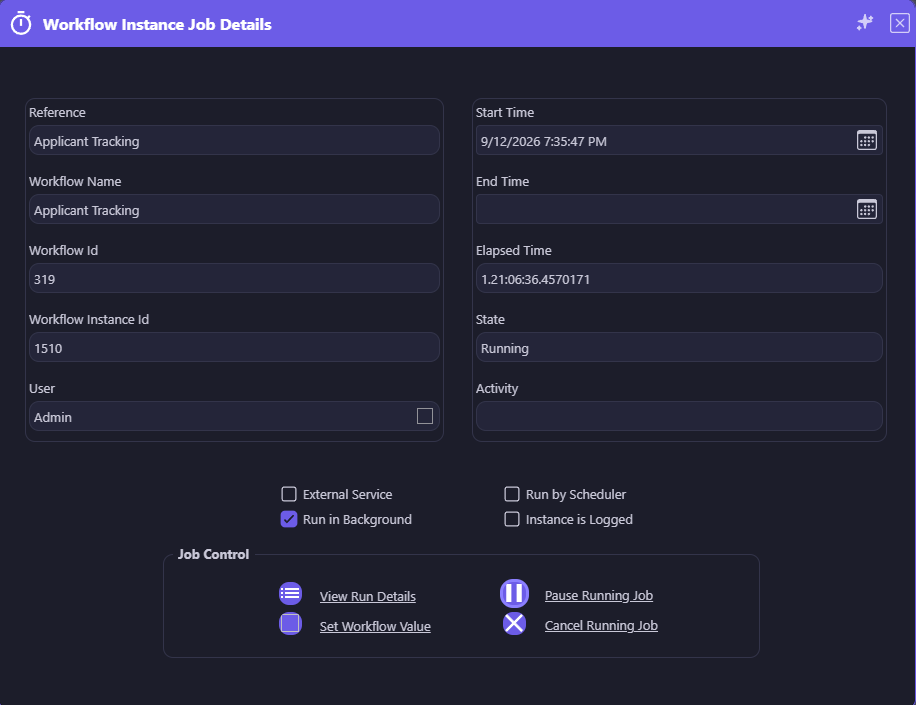
The emergency brake, built in: Job Control in the Admin Center lets an authorized user Pause Running Job or Cancel Running Job — mid-task.

Tamper-proof logs and statistics record every run, including each AI model call and its outcome.
7. Cross-Validation, Governed by Rules
Running several models on the same decision is one of the most effective ways to avoid depending on a single model, and Nadella encourages using models to test and verify each other. But he also warns where that can lead: an opaque model inside an opaque orchestration layer, watched by another opaque model — nested black boxes. His prescription is model diversity — no single model as the only basis for an important outcome, and no model checking its own work — with the controls sitting outside the models.
appRules addresses this directly. In Model Cross-Validation, no model judges another model. A deterministic rule decides what their combined results mean. Builders choose the rule in advance:
- Return the most common model result — majority agreement
- Accept the result only if all model results are the same — unanimity for the most critical decisions
- Accept the result if at least one cross-validation model matches the primary — confirmation of a primary model
- Execute a custom activity — for example, routing the decision down a different path or to human review instead of guessing
- Proceed to the next workflow activity
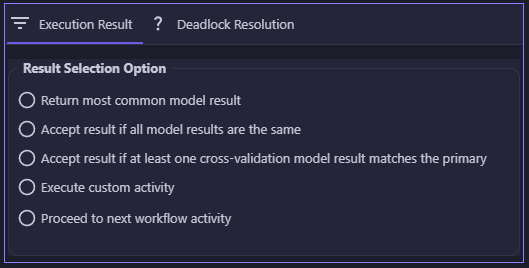
Result Selection Options: rules, not models, decide what multiple models' answers mean.
And when models cannot agree, Deadlock Resolution defines in advance what happens next — so disagreement becomes a governed outcome, not an AI's judgment call:
- Return the primary AI provider model result — defer to a designated primary model
- Return Invalid (False) as the workflow activity execution result — a fail-safe: when the models can't agree, nothing proceeds as if they had
- Return a specific value — a predetermined, known-safe default
- Execute a custom activity — for example, escalation to human review
- Proceed to the next workflow activity
The fail-safe option matters most for containment. A compromised or mistaken model can't win a disagreement by default — the rules engine can be set to treat any unresolved split as invalid, exactly as a conservative human reviewer would.
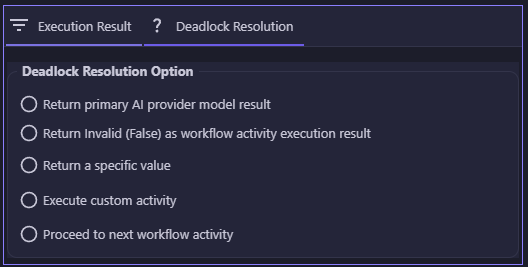
Deadlock Resolution Options: what happens when models disagree is decided in advance — including a fail-safe that returns Invalid (False).
Multiple models reduce the risk. Rules decide the outcome.
8. GuardRailed Automation: Containment by Design
Containment works best when it is designed in, not bolted on. appRules governs AI across the whole lifecycle of every automation:
GuardRailed Design
Fields, values, context, conditions, and actions are chosen from what is valid and validated as you build. The scheduler won't run an invalid workflow.
Containment at Run Time
The rules engine decides what the model's output means; validated Actions and post-conditions gate every write.
Control & Evidence
Authorized users can pause or stop any run, and tamper-proof logs record every decision for audit.
Two companion papers explore these layers in depth: GuardRailed Design for AI Workflows and GuardRailing AI.
Design guardrails stop errors from being built. Execution guardrails catch the rest.
9. Conclusion
Nadella closes his article with a line every enterprise architect should keep in mind:
“The most trustworthy Super Intelligence system will not be the one with the model we trust most. It will be the one that enables us to trust the model the least.”
— Satya Nadella, Chairman and CEO, Microsoft, Models as Insider Risks in the Super Intelligence Era, X, October 10, 2026
For enterprise automation, that is not a research agenda — it is an architecture. Separate the supply of intelligence from the authority over it. Let a mature, deterministic rules engine decide what happens. Give authorized people the power to stop any run. Record every decision in tamper-proof logs. appRules has delivered that architecture for more than a decade — and brought AI inside it.
Contain the model. Let the rules decide.
Quotations are from public statements and are used for commentary. Their inclusion does not imply any endorsement of appRules or appStrategy by the individuals quoted or by Microsoft. Microsoft is a trademark of the Microsoft group of companies. Sources: Satya Nadella, Models as Insider Risks in the Super Intelligence Era, article on X, October 10, 2026; Anthony Cuthbertson, “All AI is ‘compromised’ and has fewer rules than milk, Microsoft bosses say,” The Independent, October 12, 2026.