
The Stack in One Picture
An agentic enterprise stack has more layers than the model. Something starts the work: a person, an application, an AI assistant, or a schedule. A model reasons about it. Connectors reach the data. Systems of record hold the truth. And between the request and the record, something has to decide what the model sees, what it may do, and whether its answer is good enough to act on.
That middle layer is where appRules sits. It takes the request, assembles the context, calls the AI provider you choose, checks the answer, and only then writes to your systems.
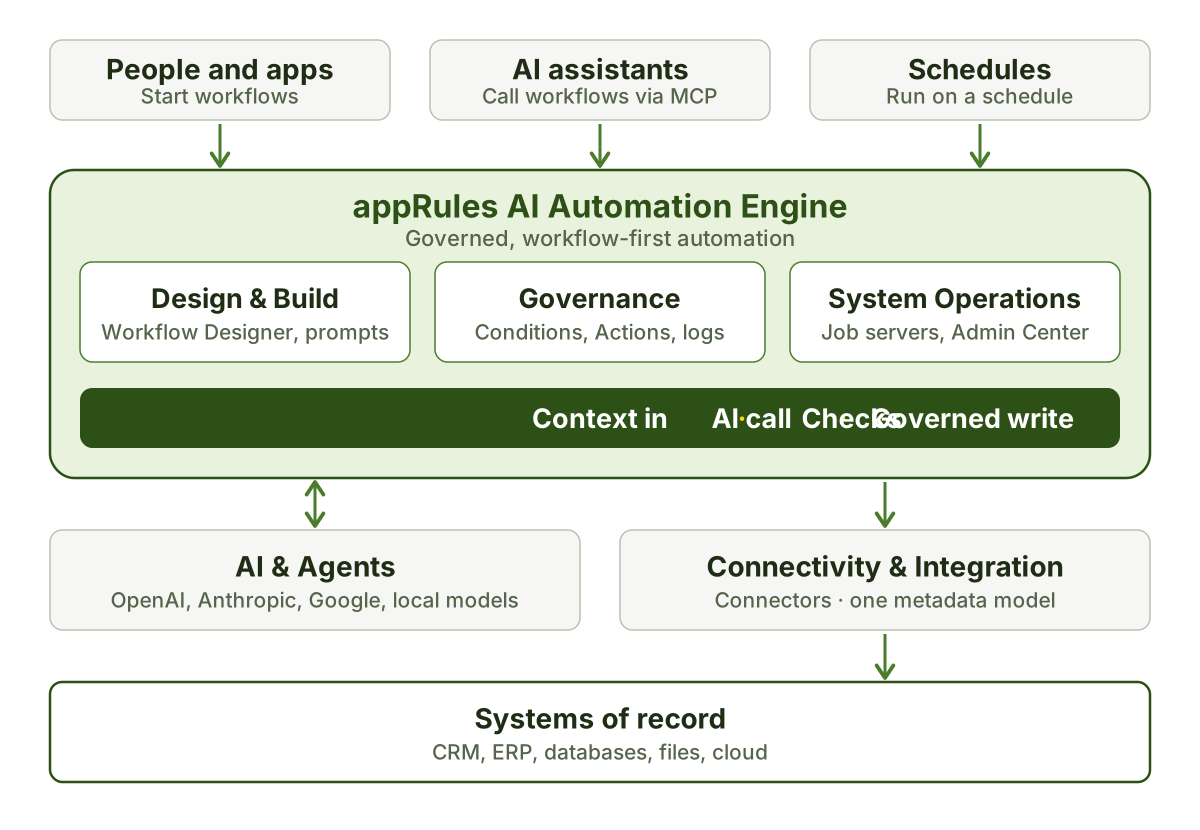
Reading from the top: requests arrive from people and apps, from AI assistants that call workflows through MCP, and from schedules. The engine runs them. The AI models are a choice made at each AI step, not the foundation of the system. Connectors carry data in and out of your systems of record.
Where the AI Models Fit
In appRules, the model is something a workflow calls, not something the workflow depends on. Each AskAI activity chooses its own provider and model, from 20+ providers including OpenAI, Anthropic, and Google, plus local models. You can switch or combine models without rebuilding the workflow. A model reads the context and returns an answer. Named Actions then carry out the operations on your systems, so the AI advises and the platform acts. See Your Choice of AI Providers.
Inside the Engine
The engine has three groups of components.
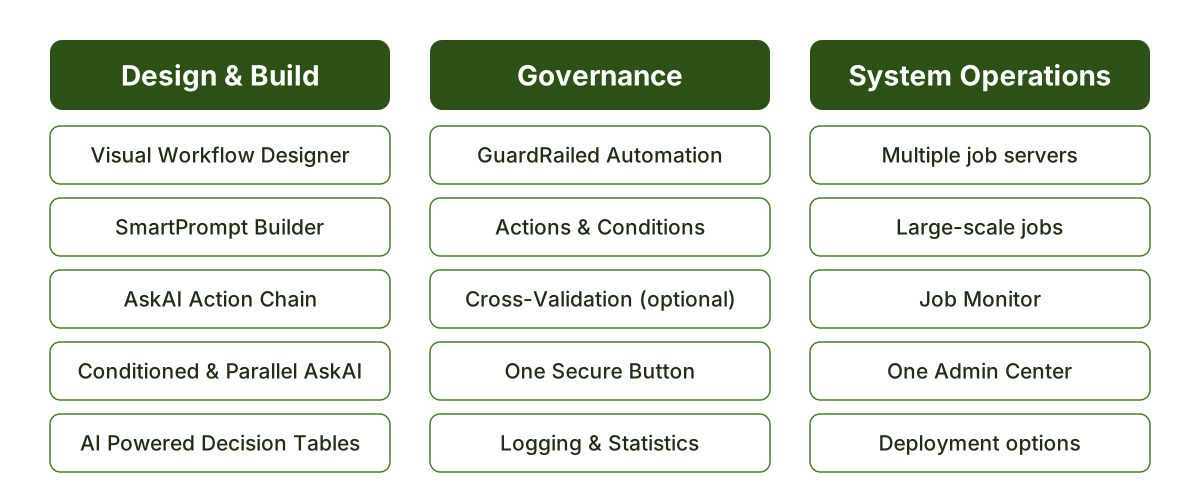
- Design & Build is where workflows and prompts are created: the Workflow Designer, SmartPrompt Builder with its Context Picker, AskAI Action Chains, parallel analyses, and decision tables. You start in no code, go further in low code, and extend in source code.
- Governance keeps AI inside limits: GuardRailed Automation, reusable Conditions and Actions, optional Model Cross-Validation, the Secure button, and Logging & Statistics.
- System Operations keeps it running: multiple job servers, large-scale and long-running jobs, the Job Monitor, one Admin Center, and your choice of where to deploy.
One Governed AI Call
A governed AI step in a workflow follows four stages, with optional controls at each one.
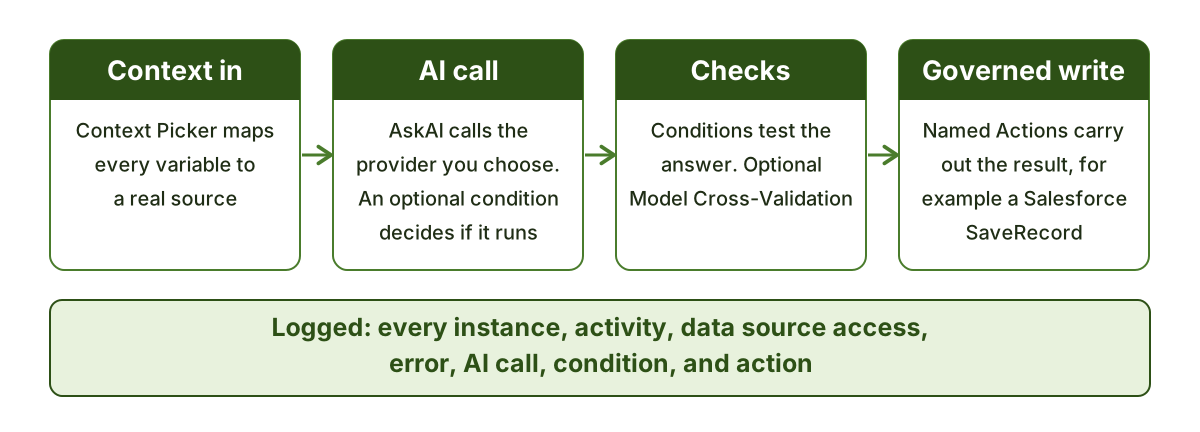
Take the loan application package review as an example. The workflow runs five analyses in parallel: income, identity, cash flow, property, and, for self-employed applicants, self-employment income. Each analysis starts with the right data from the Context Picker, and each can use the model best suited to it. An Execution Condition means the self-employment analysis runs only when it applies. A Summary activity consolidates the findings, and a SaveRecord activity updates the loan application in Salesforce. Every instance, activity, data source access, error, AI call, condition, and action is logged.
Where AI Assistants Fit
Many teams already work in AI assistants. With the appRules MCP Server, an assistant calls a governed workflow instead of reaching into your systems itself. The assistant supplies the conversation and the reasoning, and appRules holds the authority: the same Conditions, the same validated Actions, and the same record of what happened. Because MCP is an open standard, one server can serve any compatible assistant. See appRules + AI Assistants.
Questions to Ask About Any Stack
Whatever platform you evaluate, these questions show how the layers fit together:
- Where does each layer sit, and who is accountable for it?
- What happens between the AI's answer and the write to a system of record?
- Can I change AI providers without rebuilding the workflow?
- Is there a complete record of every call, condition, and action?
- How are assistants and agents I didn't build kept inside the same limits?
- Does it run at production scale, and does it work with the systems I already use?
Want the full guide? Read Beyond the Demo: How to Evaluate an AI Automation Platform. For the idea behind the middle layer, see What Is an AI Harness, and Why Does Your Enterprise Workflow Need One?
The Short Version
Models reason, connectors reach, and systems of record hold the data. Something has to govern the path between them. appRules is that layer: it controls what goes into the AI, what the AI may do, how its answers are checked, and what gets written, with your choice of 20+ AI providers on one side and your systems of record on the other.
See the Stack at Work
Start with the platform at a glance, or see how it plays out in a real workflow.